
How Thailand’s digital fiction, entertainment and fan communities reveal new ways to develop intellectual property, engage customers and extend commercial value.
By Nassera Tahanout

Thai producers present BL series to international buyers at FILMART 2025 in Hong Kong, where Thailand’s 37-company delegation reported over 2.29 billion baht in content sales.
The opportunity: Beyond the entertainment industry
A story can be more than a piece of content. It can become an audience relationship, a licensing opportunity, a live event, a consumer product or a platform for partnerships. Thailand’s entertainment ecosystem offers a useful case study in how these different forms of value can reinforce one another.
The opportunity is relevant well beyond media companies. Consumer brands, retailers, tourism businesses and technology companies all face a similar challenge: how to turn attention into lasting relationships and measurable commercial value.
Thailand’s wider digital economy provides important context. The e-Conomy SEA 2024 report by Google, Temasek and Bain & Company estimated Southeast Asia’s digital economy US$263 billion in gross merchandise value (GMV) in 2024. Thailand alone was projected to reach US$46 billion in digital-economy GMV, including US$26 billion in e-commerce GMV. These figures describe the broader digital market, not the size of Thailand’s content industry, but they illustrate the commercial infrastructure in which digital audiences, online purchasing and entertainment increasingly intersect.
The strategic question is therefore not simply how to produce content that attracts attention. It is how to design a business model in which an original idea can create value across multiple channels—and how to determine whether those extensions actually generate a return.
1. Inside Thailand’s content-to-commerce pipeline
From digital fiction to screen adaptation
One of Thailand’s most instructive examples is the development of Boys’ Love (BL) entertainment, a genre centred on romantic relationships between male characters. Its growth illustrates how stories can travel between formats and markets.
The television series 2gether, for example, was adapted from a novel by JittiRain published on the Thai fiction-sharing platform Dek-D. Its subsequent circulation included international distribution, rights sales and related releases in other markets. Nicolas Barcikowsky’s academic study of 2gether and the regional development of Thai BL traces this movement from online fiction to television and wider commercial exploitation.

2gether: The Series, adapted from a JittiRain novel first published on the Thai fiction-sharing platform Dek-D, shows how online fiction can move to the screen.
The lesson is not that every successful story can become a franchise. It is that the original format can be treated as the first stage of a broader development process. A story may first be tested with readers, adapted for the screen and then evaluated for its suitability for translation, licensing, sequels, events or merchandise.
This approach can reduce some forms of uncertainty: an existing audience may provide early evidence of interest before a larger production investment is made. However, digital popularity is not proof of future profitability. Audience size, willingness to pay, adaptation costs and rights ownership still need to be assessed separately.
The operational implication: businesses should identify which assets they are actually developing. Is the value in the story, the characters, the format, the community, the brand, or the access to a particular audience? Each asset creates different opportunities—and requires different rights, partners and investment.
Distribution is only the beginning
A content business can create value through several connected activities:
Original content: developing or acquiring a story, format, character or concept.
Adaptation and distribution: converting it into other formats or making it available in additional territories.
Audience engagement: building channels for communication, feedback and repeat participation.
Commercial extensions: testing licensing, merchandise, sponsorships, live events or tourism-related opportunities.
Long-term development: deciding whether the property merits further seasons, formats, partnerships or investment.
Not every property should move through every stage. The point is to make these choices deliberately rather than treating each release as a standalone project.
Thailand’s wider screen-production ecosystem also demonstrates how public policy can support commercial activity. According to the Thai government’s summary of foreign film-production incentives for fiscal year 2024, foreign productions received 509 million baht in rebates and generated a reported 2.876 billion baht in economic activity, while supporting more than 43,000 jobs. These are historical figures covering foreign film productions broadly, not evidence of the profitability of Thai BL series. The incentive framework has since changed: under the programme announced for implementation from January 2025, qualifying productions may receive rebates of up to 30%, without the previous overall refund cap. The wider lesson is that creative ecosystems are shaped not only by talent and audience demand, but also by production infrastructure, policy incentives and the local businesses able to capture the resulting economic activity.

Thailand’s foreign film-production incentives generated a reported 2.876 billion baht in economic activity and supported more than 43,000 jobs in fiscal year 2024.
For international businesses, the practical lesson is to map the complete value chain. A partnership may generate value for a producer, distributor, event organiser, retailer or destination—but those parties do not necessarily capture the same share of it.
2. The economics of fan engagement: From attention to value
A committed audience can support a content property beyond its initial release. Fans may discuss episodes, recommend a series, participate in events, purchase related products or follow performers across different projects. These behaviours can create opportunities for repeat engagement, but they should not be treated as automatic sources of revenue.
Research into Thai BL fan communities provides a useful qualitative perspective. A 2022 study published in the Journal of Communication and Integrated Media, based on interviews with 28 fans, examined how audiences participate in and communicate around the genre. It offers insight into fan practices, although its sample cannot establish the spending behaviour or commercial value of all fans, particularly across international markets.
For businesses, the important distinction is between engagement as a signal and engagement as an economic result. Views, comments and follower counts may indicate awareness or interest. They do not, by themselves, show whether a campaign has generated incremental sales, improved retention or strengthened margins.

Thai BL series reach Brazilian fans: the Olá BL&GL Thailand in Brazil project brought four Thai BL couples to meet audiences in person, a signal of interest rather than proof of commercial return.
Consider a skincare brand exploring a partnership with a popular entertainment property. Rather than immediately committing to a large merchandise launch or sponsorship, the brand could start with a limited pilot: a co-branded content series, a product bundle linked to the partnership, or a small online event featuring a relevant creator. The objective would be to test whether the audience’s interest translates into actions that matter commercially.
The pilot should begin with a clear hypothesis. For example, will the partnership attract new customers who are otherwise difficult to reach, increase conversion among existing followers, or encourage repeat purchases? The company could then track referral traffic, conversion rates, average order value and customer acquisition cost, comparing results with a relevant baseline or a similar campaign without the partnership. If the initiative includes a limited-edition product, pre-orders can help test demand before the business commits to a larger production run.
The same logic applies to entertainment companies. Before financing another season, expanding into a new territory or developing a live event, a rights holder can examine repeat viewing, audience retention, qualified purchase interest and early commitments from distribution or commercial partners. These indicators will not eliminate uncertainty, but they can help determine whether additional investment is justified.
The next step is to assess whether the relationship creates lasting value. Repeat purchases, event attendance and membership renewals can indicate that engagement extends beyond an initial interaction. Financial analysis should then account for the full cost of production, promotion, fulfilment, rights and partner fees. A campaign that generates substantial gross sales may still be unattractive if its costs are too high or if it mainly shifts purchases that would have happened anyway.
Businesses should use these results to make explicit decisions: scale the initiative if it meets its commercial objectives, revise the offer if engagement is strong but conversion is weak, test another audience if the response is too narrow, or stop if the economics do not work. They should also define success before launching the pilot, rather than selecting favourable metrics afterwards.

Before scaling a content or brand partnership, teams should define success in advance and review pilot results against it, then decide whether to scale, revise, retest or stop.
Yet even a well-designed pilot cannot be interpreted in isolation. Audience behaviour, distribution structures, intellectual-property rights and routes to monetisation vary across markets. A tactic that works in one country may depend on local platforms, established fan practices, particular partnership arrangements or a mature production ecosystem. To understand which lessons can travel internationally—and which require adaptation—businesses need to look beyond individual campaigns and examine the wider market structures that support them.
3. Thailand and South Korea: Different ecosystems, useful comparisons
Thailand’s content economy is particularly useful for examining the development of digital fiction, genre communities and connections between screen content and live engagement.
The comparison should not be reduced to a competition over which country produces better content. Their industries have different histories, structures, export strategies and sources of value.
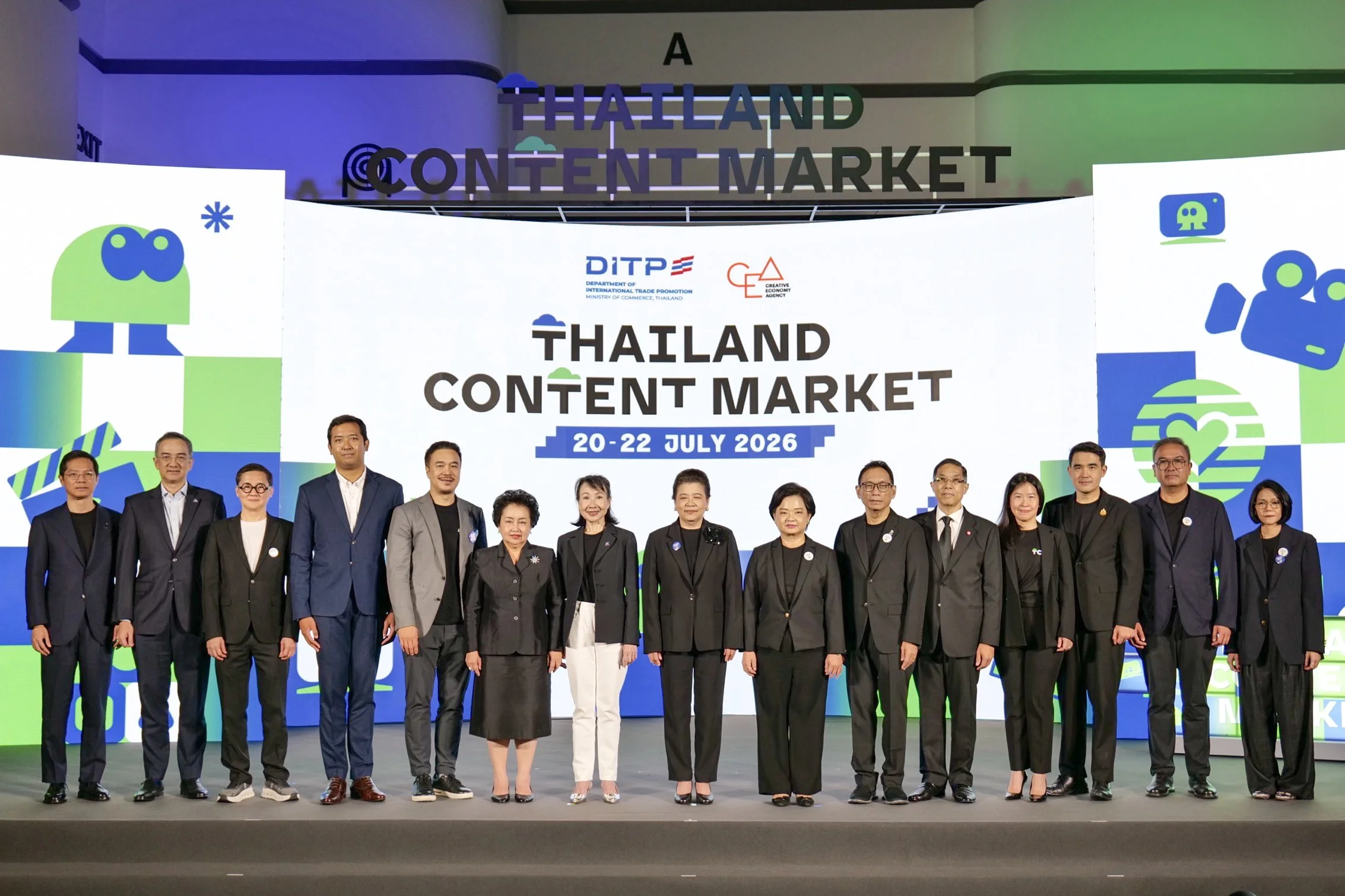
Thailand Content Market 2026 in Bangkok, organized by DITP and the Creative Economy Agency, includes a Series on Board programme connecting more than 12 Korean companies with Thai creators
South Korea offers a complementary reference point for businesses interested in the international development of creative intellectual property. The Korea Creative Content Agency’s Annual Content Industry Trend Analysis estimated domestic content-industry revenue at approximately KRW 157.6 trillion in 2024. Within that broader industry, comics revenue rose from KRW 1.53 trillion in 2020 to approximately KRW 3.11 trillion in 2024. These are domestic industry estimates, not export revenue or profit figures, and they are not directly comparable with estimates of Thailand’s BL/GL market. Their value here is to illustrate the breadth of South Korea’s content ecosystem and the importance of examining individual sectors, formats and routes to market rather than treating “Asian content” as a single business model.
For an international executive, the comparison is most useful at the level of business questions.
1. Where does intellectual property originate?
A digital novel, webcomic, television format or original production can each provide a starting point. Businesses should assess the audience, rights structure and development costs before deciding which route fits their objectives.
2. How does the property travel?
International growth requires more than translating content. Distribution arrangements, local partners, cultural context, platform access and territorial rights can all affect the opportunity. A model that works in one market may need significant adaptation in another.
3. Where is value captured?
The producer, platform, rights holder, talent agency, distributor and event organiser may all participate in the same ecosystem. Their revenue models and negotiating positions can differ substantially. A successful property does not guarantee that every participant will earn an attractive return.
4. How is the audience relationship extended?
Some businesses may prioritise a portfolio of formats and territories; others may focus on recurring engagement, live experiences or partnerships. The right approach depends on the property, the customer and the company’s capabilities.
Thailand and South Korea should therefore be treated as distinct learning environments, not interchangeable templates. The most useful comparison identifies a specific practice, explains the conditions that make it work and tests whether those conditions exist in the company’s own market.

Digital novels and webcomics are often where intellectual property starts, and where Thai and Korean stories find audiences before they travel to new formats and markets.
4. Three lessons international businesses can apply
Lesson 1: Design assets for more than one use
Businesses often invest in a product, campaign or piece of content around a single launch. A more deliberate approach asks what else the asset could support if the initial response is positive.
For a consumer brand, this might mean developing a core concept that can be expressed through short-form video, an in-store experience, creator partnerships and a limited-edition product. For a tourism organisation, it could mean connecting a cultural narrative to a visitor experience and a commercial partnership.
The operational step is to create an asset-extension map before committing to expansion. List potential formats, audiences, partners, rights requirements, costs and evidence needed to proceed. Rank opportunities by strategic fit and feasibility, rather than assuming every extension is worthwhile.
Lesson 2: Build relationships, not just reach
A large audience may create visibility, but a repeat relationship can provide more useful evidence about customer needs and preferences.
Businesses can test this principle with a small pilot: a community-led product launch, a limited event, an exclusive content offer or a partnership with a relevant creator. The goal is to learn whether the audience takes a meaningful action—and whether that action is commercially sustainable.
The pilot should define its target audience, budget, success threshold and stopping criteria in advance. It should also consider the risks of over-commercialisation. A community built around shared interests may respond negatively if every interaction becomes a sales opportunity.

Fan merchandise booths in Thailand test whether audience interest turns into purchases, but a community can push back if every interaction becomes a sales opportunity.
Lesson 3: Build partnerships around shared value
Content-to-commerce models often involve multiple participants. International businesses should be explicit about what each partner contributes and what each expects to gain.
This is especially important for cross-border initiatives, where legal rights, consumer expectations, logistics and local market knowledge may differ. A partnership should not be judged only by the visibility it creates; it should also be assessed on execution, economics and strategic learning.
5. From business insight to learning on the ground
Reports and case studies help executives identify promising models, but they rarely explain every operational detail. How are partners selected? Which metrics influence investment decisions? How are rights negotiated? What failed during implementation? Which local conditions are essential to success?
These questions are difficult to answer from published information alone. They require structured conversations with practitioners, observation of the ecosystem and comparison between companies operating under different conditions.
For an international leadership team, a well-designed learning expedition can turn this research into a more practical process. Rather than visiting organisations without a clear objective, participants can investigate a defined business question, meet relevant practitioners, compare operating approaches and translate their observations into potential actions.

Executives on a learning expedition meet practitioners on site to ask how partners are selected, how rights are negotiated and which conditions make a model work.
Learning Expedition’s role is to facilitate that structured learning: connecting executives with business environments and practitioners, then helping them identify what may be relevant to their own organisation. The aim is not to copy a successful Asian company wholesale. It is to understand why a particular approach works, what conditions support it and what would need to change before applying it elsewhere.
Conclusion: From cultural insight to commercial decisions
Thailand’s content economy offers a useful reminder that value can emerge from the connections between original ideas, distribution, audience relationships and commercial partnerships. South Korea provides a complementary perspective on the scale and development of a broader content ecosystem. Neither offers a universal formula.
For international businesses, the opportunity lies in asking more precise questions: Which assets can create value beyond their initial use? What evidence shows that an audience relationship is commercially meaningful? How should partners share costs, rights and returns? And which local conditions must be understood before a model can be adapted?
The most productive outcome of studying Asia is not a list of trends to imitate. It is a clearer set of business hypotheses to test.

From Bangkok to Seoul, studying Asia’s content economy means asking what works, why it works and what could be applied in your own market.
Discover what Asia does differently. Understand why it works. Identify what your business can learn.
