
The Customer Journey Has a New Starting Point

Advertising still surrounds consumers, but discovery increasingly starts elsewhere: with creators, communities, culture and AI.
How Culture, Creators, Communities and AI Are Redefining Consumer Discovery — What Happens When Consumers No Longer Enter Through Advertising, but Through Culture, Creators, Communities and AI?
For most of the modern advertising era, the marketing funnel offered companies a relatively simple explanation of how people became customers. Brands created awareness, advertising generated consideration, marketing nurtured intent, and sales converted that intent into revenue. The model was linear enough to measure and familiar enough to organize entire departments around it. That logic is becoming harder to sustain.
The issue is not that advertising has suddenly stopped working. Far from it. The U.S. advertising market is expected to grow by 12.3% in 2026, according to the Interactive Advertising Bureau, which revised its forecast upward in September. Yet the same study reveals how dramatically the environment around advertising is changing: 44% of advertisers now identify changing consumer behavior, including AI-driven search, as their top media investment challenge, while 76% are increasing their focus on optimizing content for AI-generated answers.
The contradiction is revealing. Companies are still spending more to reach consumers, while consumers are increasingly deciding what matters before they ever encounter a conventional advertisement. A product can now be discovered through a creator, validated by a community, discussed on social media, compared by an AI assistant and purchased through a commerce platform. A television series can create demand for a product category. A webtoon can become a global entertainment franchise. A creator's recommendation can matter more than a brand's campaign. An AI assistant can become the first interface between a consumer and a company.
The marketing funnel has therefore not disappeared. What is changing is the location of the entrance. The strategic question for CEOs and marketing leaders is no longer simply how to move consumers down the funnel. It is how to become relevant before consumers consciously enter it.
1. From advertising-led discovery to consumer-led discovery
The first major shift is taking place in the relationship between brands and attention. Traditional advertising was built around interruption. The brand purchased access to an audience and used that access to communicate a message. Digital marketing made the process more targeted and measurable, but the underlying logic remained largely intact: identify the right consumer, reach that consumer and persuade them to consider the product.
Social media has changed the economics of that relationship because consumers are no longer simply audiences. They are participants in the distribution of information.

Consumers are no longer just audiences: through reviews, videos and social sharing, they now help distribute the information that shapes brand choices.
Deloitte Digital's 2025 State of Social Research found that 83% of consumers surveyed regard the influencers and creators they follow as trusted sources of information. The same research found that 61% had discovered a new brand or product through social media during the previous 12 months, while 71% described their most recent social-commerce purchasing experience as good or excellent.
These figures matter because they reveal a change in the role of social media. It is no longer simply a place where advertising is distributed. It is becoming a place where commercial preference is formed.
Deloitte's research also shows that social-first brands are responding differently. Creators represented 24% of their average social-media marketing budget in 2024, while 48% of social-first brands said creator and influencer partnerships were producing the highest ROI among their social-media tactics. These companies are also disproportionately investing in micro and mid-tier creators, whose value comes less from mass reach than from their relationship with a defined audience. That distinction is strategically important. Reach is relatively easy to purchase. Trust is much harder to manufacture.
A creator who understands a particular community can provide something a conventional advertisement rarely can: context. The creator explains why a product matters, demonstrates how it is used, compares it with alternatives and places it within a cultural or personal frame that the audience already understands. The brand is no longer communicating entirely on its own terms.
This is why the shift toward creators should not be interpreted simply as a reallocation of advertising budgets. It represents a transfer of part of the interpretation function from brands to people whom consumers already trust. The same principle applies to communities. A strong community is not valuable merely because it contains a large number of potential customers. Its strategic value comes from the fact that members can influence one another, generate their own content, validate products and provide a continuous stream of cultural and behavioral information to the company.
Deloitte found that brands increased investment in community management by 9% year on year in 2024, while 51% of brands already using GenAI said they used it for community-management responses. The research emphasizes, however, that successful community strategy is not simply about directing consumers toward another corporate channel; it is about creating meaningful experiences that encourage engagement and loyalty. That is a very different proposition from traditional funnel management.
The company is no longer simply asking, “How do we move this consumer closer to purchase?” It is increasingly asking, “What environment would make this consumer want to participate in the first place?”
2. Culture and community are becoming demand-generation mechanisms
The most significant extension of this model occurs when the content itself becomes more powerful than the advertisement surrounding it. South Korea provides one of the clearest examples because its cultural industries demonstrate how entertainment can generate commercial demand far beyond the original piece of content.
The Korean Wave was not created as a conventional global customer-acquisition campaign. Yet Korean cultural content has increasingly become a gateway into Korean food, beauty, fashion, tourism and other consumer categories. South Korea's Ministry of Culture, Sports and Tourism found in its 2024 Overseas Hallyu Survey, based on 25,000 respondents across 26 countries, that 57.9% said their consumption of Korean cultural content had influenced their engagement with related industries, including food, cosmetics and apparel.
The following year's survey, covering 26,400 respondents across 28 regions, found that 58.9% of respondents with Hallyu experience were willing to pay for Korean products or services. Food generated the highest purchase intention at 66.2%, followed by beauty products at 57.1%. Visiting Korea ranked first among the services measured, at 64.1%. The strategic significance is not the popularity of Korean culture by itself. It is the sequence through which demand is created.

Food and beauty lead the list: among respondents with Hallyu experience, purchase intention reached 66.2% for Korean food and 57.1% for beauty products.
The consumer may first encounter a drama, a musician, a webtoon or a cultural trend. The initial relationship is emotional or cultural rather than commercial. Interest creates curiosity; curiosity leads to communities, recommendations and exploration; only later does the consumer encounter products and services associated with that cultural universe. The advertisement therefore becomes optional.
This is a fundamentally different way of thinking about customer acquisition. Instead of beginning with the product and trying to create demand around it, the company can participate in an ecosystem that creates desire, relevance and cultural meaning before the transaction exists.
South Korea's webtoon industry illustrates the mechanism particularly well. Domestic webtoon revenue grew from approximately KRW 379.9 billion in 2017 to KRW 2.286 trillion in 2024, according to Korean industry data reported by Yonhap. The market passed KRW 1 trillion in 2020 and exceeded KRW 2 trillion for the second consecutive year in 2024. But the more consequential development is what happens once a story has established an audience.
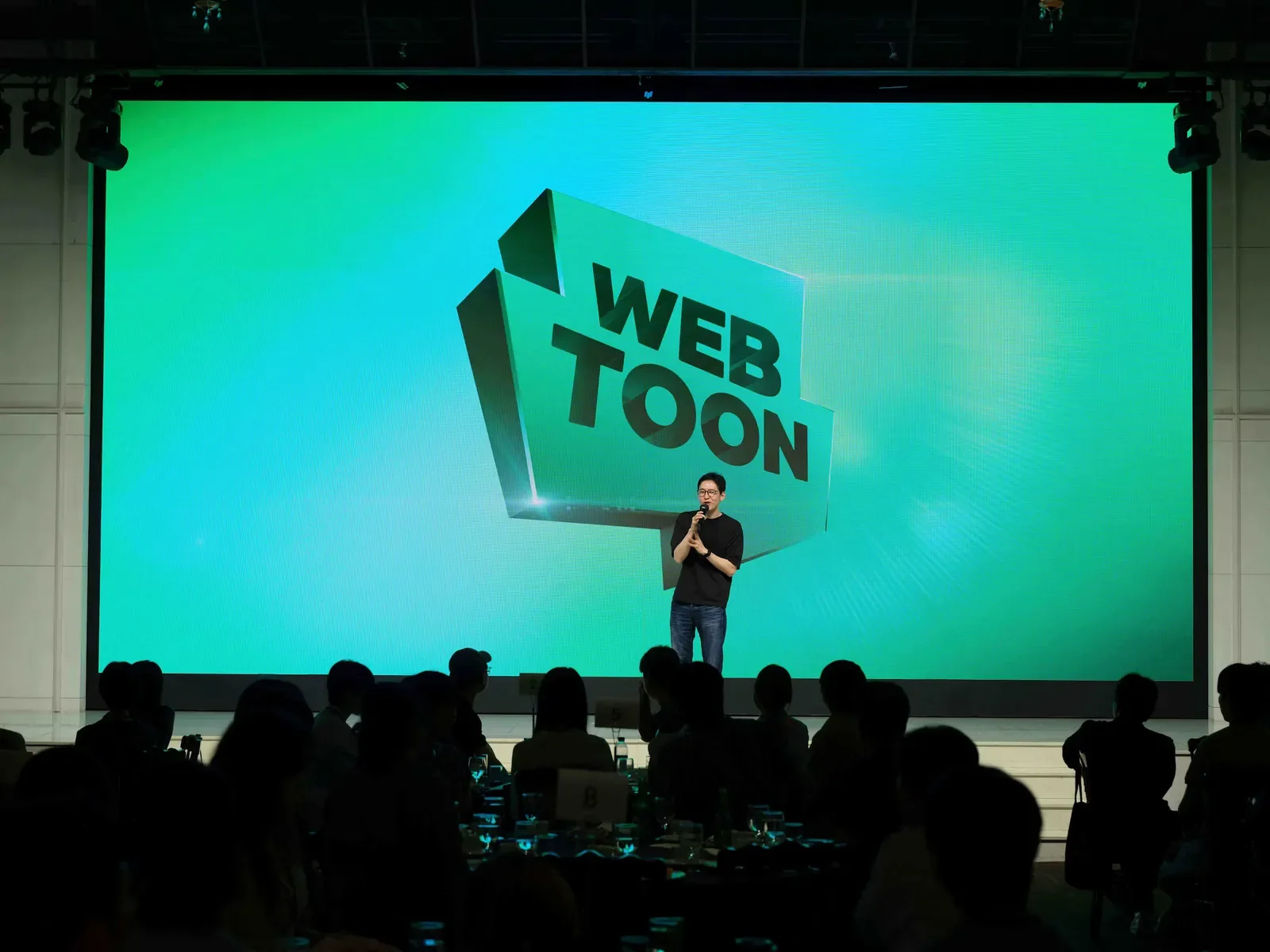
South Korea's webtoon market grew from KRW 379.9 billion in 2017 to KRW 2.286 trillion in 2024, turning digital comics into a major content platform.
A webtoon can become a television series, film, anime, game or licensing property. WEBTOON Entertainment generated $1.383 billion in revenue in 2025, while its IP Adaptations business reached $130.95 million, up 31.8% year on year. The business is consequently moving beyond monetizing the audience around content toward monetizing the intellectual property created after attention has been established. The strategic importance of this model was reinforced in January 2026, when Disney completed an approximately 2% investment in WEBTOON Entertainment and announced plans for a new digital comics platform combining Disney properties with selected WEBTOON Originals. This is not simply a media partnership. It illustrates a broader shift in the economics of content.
The content itself can become the customer-acquisition mechanism, the community platform and the intellectual-property pipeline. The lesson for Western companies is not that every brand should become an entertainment company. It is that companies increasingly need to understand whether they are merely buying attention or creating something that generates attention organically. That distinction will become more important as advertising becomes easier to produce and harder to differentiate.
3. AI is not eliminating the funnel; it is moving the decision-making layer outside the brand
Artificial intelligence introduces another disruption because it changes not only how companies produce marketing but also how consumers discover and evaluate products. For two decades, search engines provided the principal interface between consumer intent and commercial information. Companies optimized their websites for search visibility, attracted traffic and attempted to convert that traffic.
Generative AI introduces a different interface. A consumer can now ask an AI assistant to compare products, summarize reviews, identify alternatives or recommend a solution without necessarily visiting the websites that supplied the underlying information.
The shift is already visible in advertising investment. IAB's September 2026 research found that 44% of advertisers consider changing consumer behavior, including AI-driven search, their top media investment challenge. At the same time, 76% are increasing their focus on optimizing content for AI-generated answers. Most significantly, 86% say they are changing or expect to change how they measure media performance because of conversational AI and AI agents over the next 12 months.

76% of advertisers are now optimizing content for AI-generated answers, and 86% are changing how they measure media performance because of conversational AI.
This represents a profound change in the economics of visibility. A company can no longer assume that being visible in a search engine is sufficient. Increasingly, it needs to be accurately represented in the systems that interpret information on behalf of consumers. The problem is no longer simply whether someone can find the company. It is whether the system they trust understands what the company does, why it matters and how it compares with alternatives.
This is why AI search optimization is becoming more than an SEO extension. It is becoming a question of brand authority, structured information, expertise and digital reputation. There is, however, a critical paradox. AI can dramatically increase the quantity of content available to consumers while simultaneously reducing confidence in that content.
Gartner reported in September 2026 that 65% of consumers surveyed believe brands are producing too much AI-generated content, while 57% say the prevalence of this content has made them less trusting of brand messaging overall. Gartner's research also found that 35% of consumers now rely less on influencers for shopping information and recommendations because of AI, while 43% rely more on real people because AI-generated content has become so prevalent. The apparent contradiction is actually the point. AI is reducing the value of generic information while increasing the value of credible human experience.
That creates a new hierarchy of trust in which expertise, authenticity, transparency and demonstrated experience may become more valuable precisely because synthetic content is becoming ubiquitous.
4. The strategic challenge for CEOs is no longer managing a funnel, but managing an ecosystem of influence
Taken together, these changes point toward a different operating model for marketing. The funnel remains useful inside an organization. Companies still need to measure awareness, consideration, conversion and retention. What no longer works as reliably is the assumption that consumers will encounter those stages in a predictable sequence or that advertising will control the beginning of the journey. The customer journey is becoming more fragmented and more external to the company.
A consumer may encounter a creator before the brand, a community before the product, a cultural phenomenon before the category, or an AI recommendation before a conventional search result. These encounters may occur across platforms that the company does not own and cannot fully control. The consequence is that marketing strategy increasingly overlaps with product strategy, customer experience, community management, creator relations, cultural intelligence and information architecture.

Customers no longer enter through a single road: creators, communities, culture and AI now open entrances that brands don't control.
This is also why simply increasing content production is unlikely to solve the problem. If every competitor can use AI to produce thousands of articles, videos and social posts, content volume becomes less differentiating. The real competitive question becomes what the company can offer that people have a reason to discuss, trust and return to.
Deloitte's research shows where sophisticated organizations are already moving. Social-first brands are concentrating investment around community, content and conversion, while using creators and user-generated content to strengthen trust and reduce the distance between discovery and purchase. Social-first brands also report that 14.4% of their B2C revenue comes from social commerce, compared with 10.5% for lower-maturity brands.
The IAB's September 2026 research points in the same direction from the advertising side. Creator and influencer advertising or partnerships were the area receiving the greatest increased focus, cited by 54% of advertising buyers, followed by cohort-based advertising at 53%. What emerges is not the disappearance of paid media but its integration into a much broader system of influence.

Creators act as a trusted layer between brand and consumer: 54% of advertising buyers are increasing their focus on creator and influencer partnerships.
Advertising can create reach, but reach alone does not guarantee relevance. Creators can provide credibility, but credibility without a strong product eventually collapses. Communities can generate advocacy, but communities without genuine value become distribution lists. AI can accelerate discovery, but recommendations without trustworthy underlying information can undermine confidence.
The strongest model therefore combines these elements rather than treating them as disconnected marketing channels. The company creates something genuinely valuable. Culture gives it meaning. Creators interpret it. Communities validate and circulate it. Search and AI make it discoverable. Commerce captures the resulting demand. This is fundamentally different from asking an agency to build a campaign and then measuring how efficiently that campaign moved consumers through a predefined funnel.
It is closer to building an ecosystem in which demand can emerge from multiple directions. For senior executives, that distinction has consequences well beyond marketing. It affects where budgets are allocated, which capabilities sit inside the organization, how brand performance is measured and even how products are designed. If consumers increasingly discover products through communities, creators and AI systems, then the company's reputation outside its own channels becomes as strategically important as the communications it controls internally.
The question is no longer simply how much the company spends to reach a consumer. It is how much influence the company has before the consumer becomes a customer.
In conclusion, the funnel is not dead. The starting line has moved.
The most useful way to think about the end of the marketing funnel is therefore not as the disappearance of advertising or the triumph of AI. It is the disappearance of a much older assumption: that the company controls where the customer journey begins.
Consumers can now enter through culture, creators, communities, entertainment, social commerce, search or AI. They can form opinions before they ever encounter a branded message, and they can validate or reject that message through networks the company does not control. That does not make advertising irrelevant. It makes advertising one component of a much larger influence system.
The strategic shift is from capturing attention to earning relevance. South Korea's cultural economy demonstrates how powerful that principle can become when entertainment, community and commerce reinforce one another. The country's official Hallyu research provides measurable evidence that cultural consumption is associated with demand for Korean products and services, while the expansion of webtoon IP demonstrates how content can evolve into a much broader commercial asset.
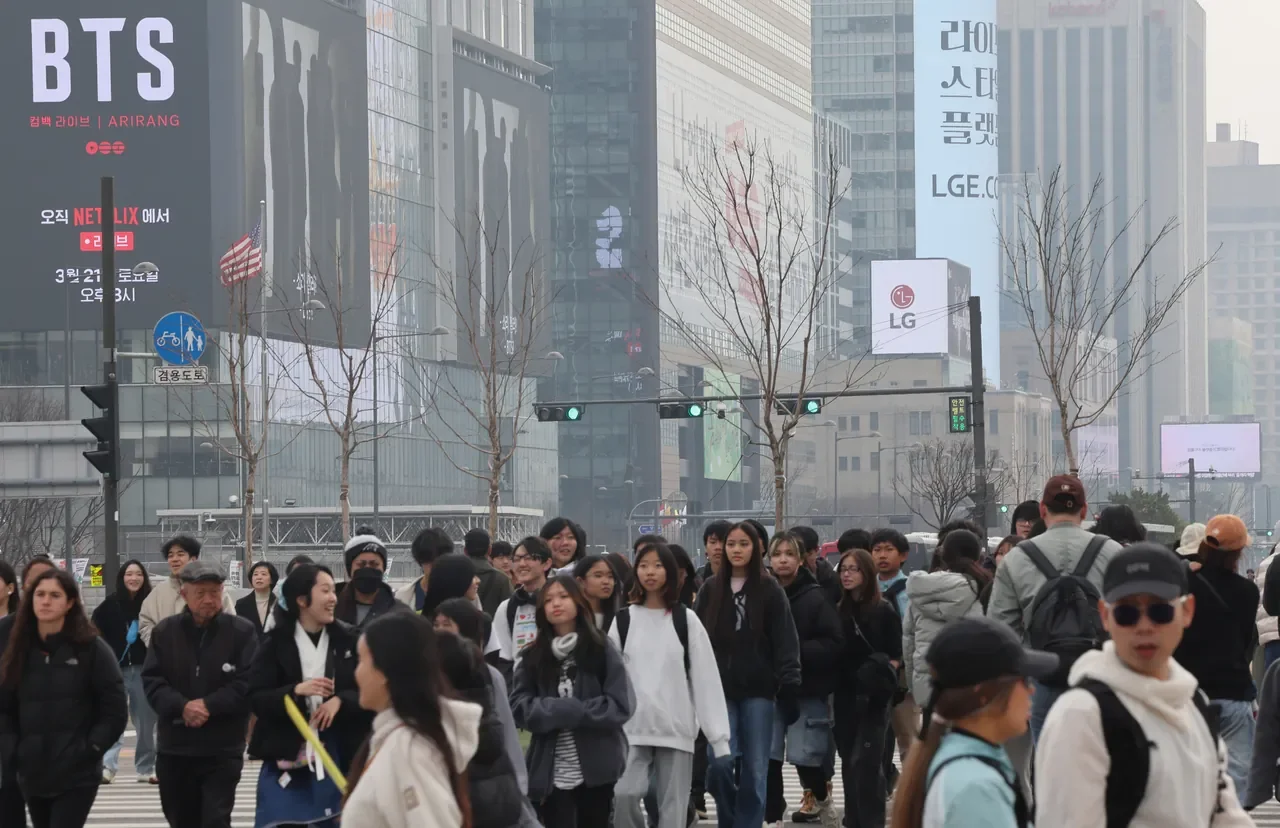
Culture now arrives before the advertisement: in Seoul, a BTS comeback concert billboard towers over pedestrians near Gwanghwamun Square.
Creator marketing demonstrates how trust can migrate from corporate communications toward individuals and communities. AI is now adding another layer by becoming an increasingly important interface through which consumers research and evaluate their options. The latest IAB research shows that advertisers are already adapting to this reality, while Gartner's latest findings demonstrate the other side of the equation: consumers are becoming more selective about what, and whom, they trust. For CEOs and marketing leaders, the implication is straightforward but consequential.
The companies that remain focused exclusively on moving consumers down a funnel may continue to optimize an increasingly smaller part of the journey. The more strategic question is what happens before the funnel begins.
Can the company create cultural relevance? Can it build a community that people value independently of the transaction? Can it work with creators whose credibility extends beyond a paid endorsement? Can its expertise and digital presence be understood and surfaced by AI systems? And can all of those interactions reinforce one another rather than operating as disconnected marketing initiatives?
The answer will increasingly determine how brands compete for attention, trust and demand. Because the next generation of marketing may not begin with a company asking: “How do we reach the customer?” It may begin with the customer asking: “Who should I trust?” And the companies that are already part of that answer will have entered the relationship long before the advertisement appears.