
Why Physical Experience Is Arguably More Important in the Age of AI
Today, our world has more access to information than ever before, and leaders are no different.
Artificial intelligence can summarise customer sentiment in seconds. Social platforms reveal behavioural trends in real time. Dashboards translate millions of interactions into clean visual narratives. In fact, for the first time in human history, executives can “observe” markets continuously without physically entering them.
Yet as informational access expands, a quieter question is emerging inside organisations:
If leaders can analyse behaviour everywhere, why are physical experiences still the most transformational?
In a piece in Harvard Business Review on Where Companies Go Wrong with Learning and Development, it revealed that organizations spent $359 billion globally on training in 2016, but programs often fail to build real collaborative and adaptive skills needed today and application rates remain low. The missing component? Real world context. The explicit, but most importantly, the tacit knowledge one accumulates from being in physical environments.
And this answer reveals an overlooked truth about modern leadership – one that becomes more important, not less, as AI advances.
Why AI Makes Experience More Valuable
When information becomes abundant, competitive advantage shifts away from access to data and information and more toward insights and interpretation.
Two leaders can receive identical AI-generated insights and reach entirely different conclusions. What differs is not the data, but how each leader interprets it – a capability formed through the interplay between natural judgment and exposure to real operating environments.
Organisational research suggests that managerial judgment improves when leaders combine analytical reasoning with experiential learning, allowing them to recognise patterns that are not yet fully visible in quantitative data.
Physical exposure calibrates intuition. It teaches leaders what to notice. But, without that calibration, AI will generally just reinforce existing assumptions rather than challenge them.
This is particularly visible when organisations explore major transformation themes such as digital transformation, customer experience, and artificial intelligence itself. While AI can analyse vast datasets and simulate potential outcomes, it cannot fully replicate the contextual understanding that leaders gain from observing how technology, operations, and customer behaviour interact in real environments.
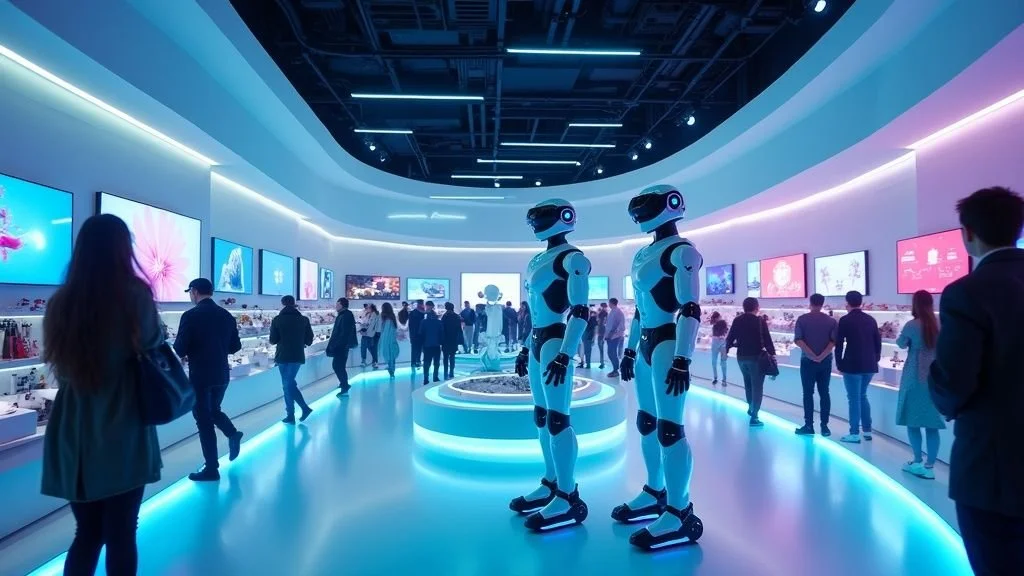
For example, during a recent Learning Expedition in China, a client from the home improvement retail sector interacted directly with the latest humanoid robotics platform developed by UBTECH Robotics. Seeing the robot operate within industrial and logistics environments immediately shifted the leadership team's perspective from theoretical discussion about automation to practical consideration of how such technologies could reshape warehouse operations and service models.
The Problem of Distance
Modern organisations unintentionally create distance between leadership and reality.
As companies scale, executives increasingly encounter customers through summaries rather than situations — insights instead of interactions. Decision-making becomes mediated by interpretation layers designed to simplify complexity.
McKinsey & Company has found that organisations maintaining continuous engagement with customers significantly outperform peers, with companies effectively integrating customer insight into decisions achieving substantially higher growth rates.
Take, for example, JPMorgan Chase’s CEO Jamie Dimon. Dimon has long emphasised direct exposure across the organisation, regularly visiting branches, meeting frontline employees, and engaging with clients alongside reviewing extensive analytical reporting. Rather than relying solely on executive summaries, Dimon has argued that leadership judgment depends on understanding how decisions unfold in practice having been recorded encouraging other executives to “get on the bus and go to a branch.”
Today, JPMorgan Chase has grown into the largest bank in the United States and one of the most consistently profitable and highly valued financial institutions globally.
The implication is not that data fails, but that distance distorts.
When leaders operate exclusively within informational environments, markets appear more stable and predictable than they actually are. Physical exposure restores uncertainty — and with it, accuracy.
Shared Experience Creates Alignment
There is another consequence of shared experiences among groups which often goes overlooked, and that is alignment.
Strategic disagreement frequently arises not from conflicting goals but from different mental pictures of reality – different truths. When leadership teams experience markets together – observing customers, competitors, and operating environments firsthand – discussions shift from opinion toward shared interpretation.
The conversation changes subtly but significantly:
from What do we think is happening?
to What did we observe?
Shared experience reduces abstraction and accelerates execution because leaders begin from a common reference point.
Closing the Distance Between Leadership and Reality
The rise of AI has not eliminated the need for physical experience. It has clarified its purpose: Information is now abundant. Perspective is not.
As organisations rely more heavily on intelligent systems to process complexity, leadership advantage increasingly depends on maintaining contact with the environments where behaviour actually unfolds.
AI can describe the market with extraordinary precision. But understanding still begins with seeing – not through a model, but within the world the model attempts to represent.
And in an age defined by artificial intelligence, the leaders who step closest to reality may ultimately interpret it fastest.
If you’re interested in learning more about our programs at Learning Expedition, please contact krystal@learningexpedition.co